

<< Back to All Insights

Child Support

What is child support?

Child support is money paid by a parent for the support of a child. A court can order a parent to pay child support and does in almost every single case before the court. It is considered in the best interest of a child for child support to be paid. It is also possible for judges to order retroactive child support or “back child support” in some instances. For example, if you knew you had a child and intentionally avoided paying child support or did not provide financial assistance. Texas courts generally use the child support guidelines provided in the Texas Family Code to establish child support.

What is an “obligor?”

The person paying child support. Sometimes this person is referred to as an “NCP” or “non-custodial parent.”

What is an “obligee?”

The person receiving child support. Sometimes this parent is referred to as “CP” or “custodial parent.”

How long is child support payable?

Child support lasts until whichever happens later:

  • The child turns 18; or
  • The child graduates from high school.

However, if your child has a disability, child support can continue for as long as necessary for the child.

How do I pay child support?

Most people pay through wage garnishment. Texas requires income withholding orders. If you have an employer, it will start being garnished from your pay check after the judge signs the order. The judge will also sign what is called an “Income Withholding Order.” It usually takes a couple weeks to kick in and its a good idea for you to give a copy of both orders to your HR Department (or whoever does your payroll.) Otherwise, you can pay online at Office of the Attorney General or by check payable to the TX SDU (through the Office of the Attorney General). You will need your OAG number to set up your online account. It is your responsibility (not your employers) to make sure the support is timely paid so always review your paycheck and check the online OAG portal – if you don’t see a payment, pay through the portal.

Can’t I just pay the other parent directly?

NO! You do not get credit for informal payments. Consider it a bonus payment to the other side that will not be credited towards your child support obligation.

How is child support calculated?

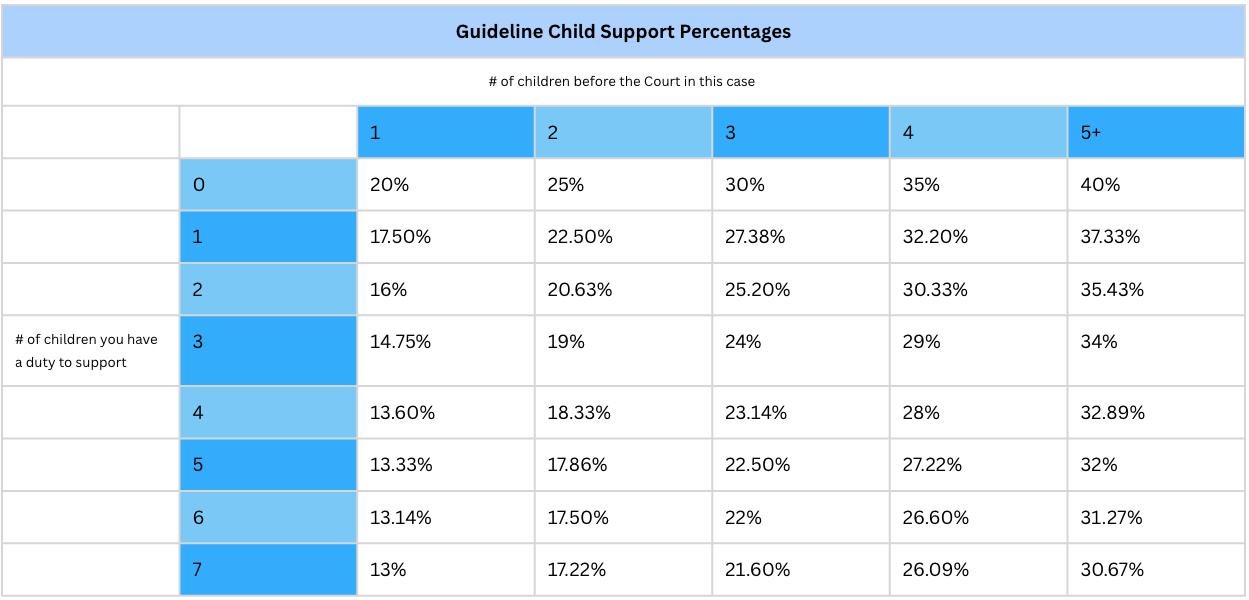
Texas courts use the child support guidelines to establish child support in most cases. The guidelines set out percentages based on the number of minor children before the court and the obligor’s net resources. Here are the basics:
What is the income “cap” for calculating child support?

The court generally looks to the first $11,700 of the obligor’s net resources.

What are “net resources?”

Net resources is most sources of income minus a few mandatory deductions. More specifically, the following are deducted from gross income: Social Security and Medicare taxes; Income tax for a single person; the cost of covering the child or children on health and dental insurance IF the obligor is providing or paying for insurance, union dues, and some types of retirement contributions.

Here are the frequently used income sources which may be counted for the purposes of establishing child support:
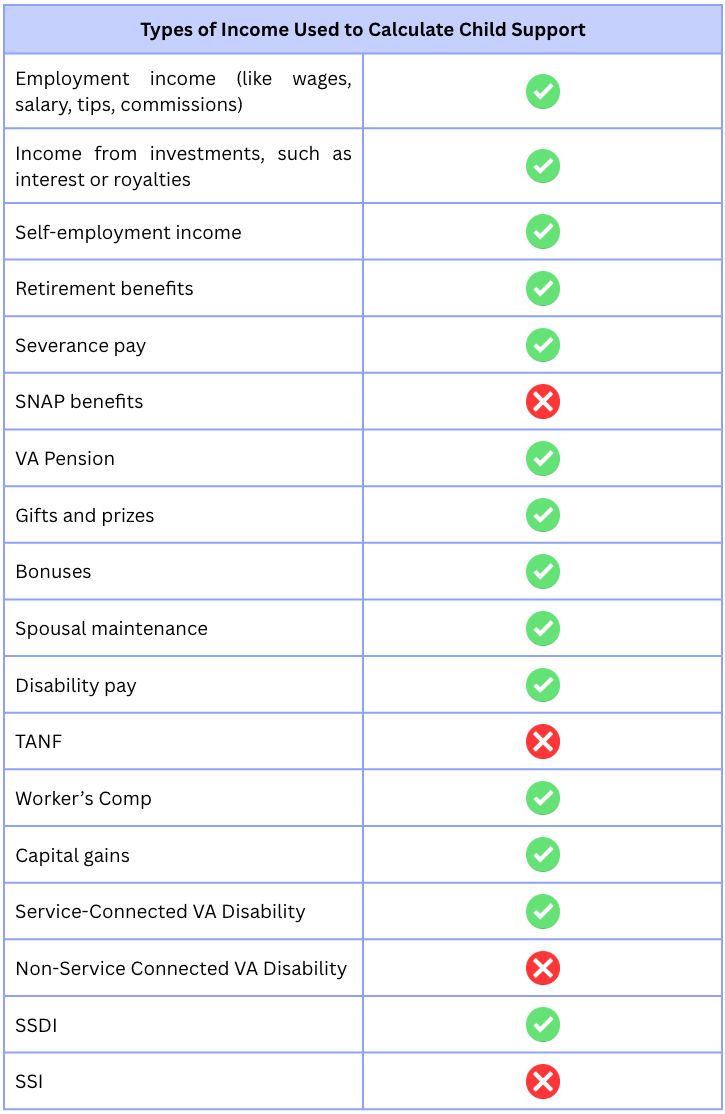
Screenshot 2026-01-06 at 12.41.00 PM

What if the obligor isn’t working?

The Court can still assess child support. It is assumed by the Court the person can at least make minimum wage. If there is employment history by the obligor, the court can assess child support based on what the obligor would be making if they were working.

Can the court order above-guideline child support?

Yes. In some instances, the court may assess above-guideline child support. Generally, the court operates using the guidelines but there may be factors the court will deviate. For example, if one parent lives far away and never visits the child, that could be a reason for above-guideline child support.

Call our office today at 214-528-3344 to schedule a consultation and learn about how child support laws affect your prior order or your pending litigation.


<< Back to All Insights

Enforcing Tx Child Support Can Be Complicated When A Parent Relocates

In Texas, state child support enforcement services include finding absent parents, but a parent’s relocation can make enforcement challenging.

After a divorce, many Dallas parents make every effort to fulfill their responsibilities and stay involved in their children’s lives. However, some parents fail to cooperate with court orders or provide their children with financial support. When this happens, the Office of the Attorney General’s Child Support Division steps in to enforce child support orders. Unfortunately, the enforcement process can become complicated when one parent is absent or has relocated.

Enforcement measures

The Office of the Attorney General can take various steps to ensure that children and custodial parents receive due support. Once a non-custodial parent stops paying child support, the custodial parent can request enforcement services from the OAG. The OAG may use several measures to forcibly collect overdue support from the non-custodial parent, including the following:

  • Intercepting state or federal payments to the parent, including tax refunds and lottery winnings
  • Placing liens against property that the parent owns
  • Directly taking payments from the parent’s pending paychecks through wage withholding
  • Suspending the parent’s driver’s license and any professional or recreational licenses
  • Filing a lawsuit, which may result in jail time and a judgment for overdue support

If a non-custodial parent is absent, the OAG works to locate the parent based on the parent’s personal information. This includes age, Social Security number, personal relationships and personal interests. Although this approach is often effective, it may fall short when parents have crossed state liens or entered temporary living situations.

Relocation issues

One Texas parent’s story illustrates the complications that can arise in these situations. According to KRGV News, the custodial parent has struggled for years to collect support from the other parent. The absent parent was recently found staying at a motel in Texas. However, the parent’s last known official address was in California. When that address was registered, the parent’s case was passed on to the attorney general in California.

Due to this change, the OAG in Texas currently lacks authority to serve the absent parent with a court order. If this parent becomes officially employed in Texas, the case should pass back to the OAG. The same is true if the non-custodial parent takes up residence under a real address. Otherwise, enforcements depend on the attorney general in California.

Only about 10 percent of Texas child custody cases are transferred out of the state, according to the OAG. Delinquency is reportedly rare in those cases. Furthermore, Texas has one of the highest rates of successful collection of overdue child support, according to the KRGV News. Still, this case helps illustrate the complications that can arise when parents refuse to comply with support orders.

Seeking legal assistance

Consulting with an attorney can be a beneficial step for anyone facing issues with unpaid child support in Texas. Enforcing support orders can be a difficult and confusing process, especially when there are complicating factors such as parental relocation. A family law attorney may be able to offer advice on the relevant laws and approaches to resolving the situation.

Keywords: divorce, relocation, children

<< Back to All Insights

Finding Help Sealing Your Criminal Record

In some cases, it’s possible to clear criminal history off your record so that background checks do not reveal it. This article looks at the different approaches available, and how the process is actually done.

Under the law of the state of Texas, making a criminal mistake doesn’t necessarily define you for life. A conviction doesn’t have to stay on your record forever. In certain cases, the Texas Code of Criminal Procedure affords individuals who have a criminal conviction on the record, the ability to have it expunged. If you carry out the legal process correctly, it is possible to either seek an Expunction or a Certificate of Non-disclosure, both options giving you the ability to truthfully say that you have never been charged with a crime or convicted of one.

The Order of Non-Disclosure

If you’re accused of a crime, plead guilty, and are on deferred adjudication, your guilty plea is sent to the National Crime Information Center and the Texas Crime Information Center. Once your record gets on these databases, anyone doing a background check is able to see it. Such a search doesn’t turn up anything, however, once you successfully apply for a certificate of non-disclosure. It’s important to keep in mind that deferred adjudication isn’t an option for certain serious offenses, and, even if one is granted, it may be withdrawn if you are convicted of a fresh offense.

In addition, if you’re on felony deferred adjudication, a certificate of nondisclosure is only granted five years after the completion of the period. Waiting periods are generally not required for misdemeanors. You are able to find out whether you are eligible for such an order, by talking to an experienced criminal lawyer.

Expunging a record

It may be possible to have your name removed or expunged from the criminal information databases, altogether. This would be a step beyond the grant of an order of non-disclosure. Arrests that lead to no criminal charge, criminal charges that are dismissed at some point, juvenile offenses, and criminal charges in which the defendant undergoes pretrial intervention, may all qualify.

On the other hand, in some cases, an expunction may not be possible. This is generally true when a person has a new felony conviction or deferred adjudication within five years of the crime that he or she wishes to see expunged. It’s also important to keep in mind that an expunction is only an option once the statute of limitations for the crime in question has passed.

How can a criminal lawyer help you seal your criminal record?

Applying for an expunction or an order of nondisclosure can be a demanding and complicated process for anyone who doesn’t have experience with it. The first step to take would be to speak with an experienced criminal lawyer about how likely it is that you would qualify for one of these approaches to sealing your record. Once it is determined that your circumstances would allow you to qualify, the next step would be to draft a petition and file it with the district clerk’s office. Contacting the court that originated your charges is a step to take, as well, so that you can obtain a date to present your case to the court about clearing your record. Your lawyer could be an invaluable ally through this stage.

Once the hearing is through and your petition is approved, your lawyer follows up with the criminal record databases at the national and state levels to ensure that your record is cleared.

Clearing your record is a complex process, and needs to be handled with technical skill. When it is done correctly, you can count on having a blemish-free record.

<< Back to All Insights

Is A Peaceful Divorce Possible?

Mediation and collaborative law are two popular uncontested divorce options. These methods may reduce conflict and cost less than litigation.

Getting a divorce may conjure up images of lengthy and contentious court battles, as well as icy meetings with exes during child visitation changeovers. While it is true that most divorces have some degree of contention, uncontested divorces are gaining in popularity and changing how family law is done for many people in Texas and elsewhere.

Two of the most common ways of ending a marriage through uncontested means are mediation and collaborative law. According to U.S. News and World Report, both methods may have advantages over traditional litigated divorce. However, both options are different from each other, have a few limitations and may not work for everyone. It is important to understand how each method works before making a decision.

Mediation

This method of uncontested divorce involves a neutral third party, who sits with the divorcing couple and helps them reach solutions to their disputes that they both can live with. The neutral party may be a certified mediator or an attorney who has experience in this method. Often, family law attorneys are also certified mediators.

The American Bar Association states that mediation is an attractive option to many couples because it can cost significantly less than litigation, often takes less time and is private. Couples may learn negotiation and communication techniques that may continue to benefit them throughout their lives. Mediation is also known to reduce conflict, which may be especially beneficial for couples with children.

Collaborative law

A collaborative divorce has many of the same advantages of privacy and negotiation strategies common to mediation. In addition, a collaborative divorce involves each party’s own attorney. Divorcing spouses may consult with other professionals, such as financial advisors and child therapists. Collaborative law may be an effective option for those with complex disputes. Each party signs an agreement not to go to court, which may provide an incentive to cooperate with each other. If an agreement cannot be reached, the attorneys must resign and each spouse must find new attorneys.

There are some cases in which uncontested divorce may not be possible or advisable. For example, spouses who experienced domestic violence or substance abuse may find it difficult to treat each other respectfully during mediation sessions. It is necessary that couples are able to talk to each other civilly, to keep an open mind and to compromise when choosing an uncontested divorce method. It may be necessary to speak with an experienced Texas family law attorney about the method that is best suited for each situation.